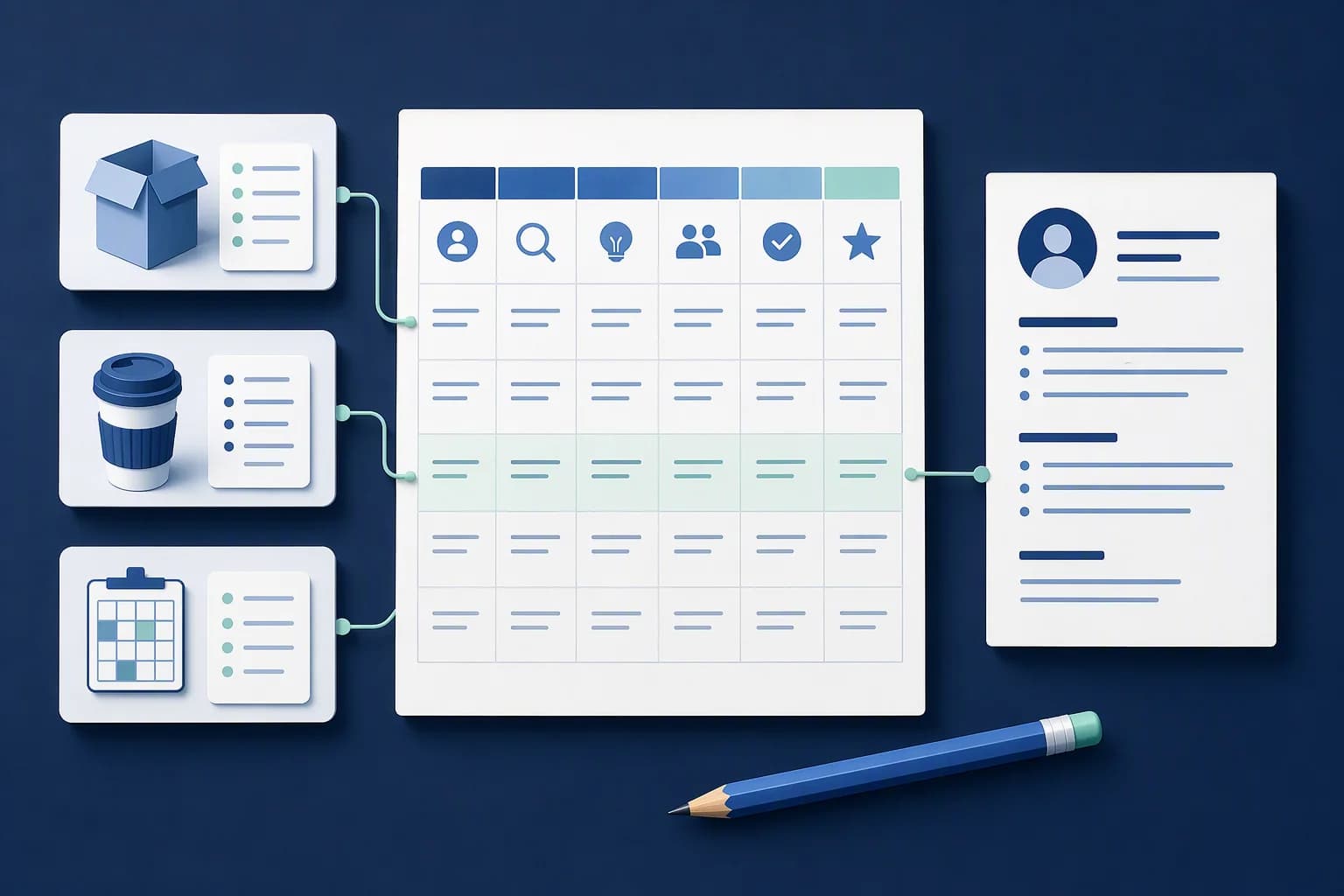
Skills gap analysis: build a personal learning plan
Compare target roles with evidence of your current skills, choose a useful gap and build a small project that shows what you can do.

What is a personal skills gap analysis?
A personal skills gap analysis compares the capabilities needed for a target role with what you can currently demonstrate. It helps you decide whether to learn something new, practise a skill in a harder setting or explain existing experience more clearly. The output should be a short learning plan with an observable result.
Start with a role you would realistically pursue. Collect several recent descriptions for similar responsibilities and seniority in your target market. If your direction is still unclear, first create a focused job search plan. Combining unrelated roles produces a long wish list that is difficult to act on.
In the World Economic Forum's Future of Jobs Report 2025, surveyed employers expected an average of 39% of workers' existing skill sets to change or become outdated between 2025 and 2030. Its 2024 survey covered 1,043 mainly large employers across 55 economies. These are employer expectations, not a measure of your own skills gap. Use that context as a reason to revisit your plan, while choosing what to learn from the roles you actually want.
Translate job descriptions into capabilities
Group repeated responsibilities rather than copying every tool name. For example, different monitoring platforms can support the shared capability of investigating a production incident. Keep a named tool separate when the employer explicitly requires experience with that tool; related knowledge does not automatically satisfy the requirement.
The UK's National Careers Service skills guidance recommends checking job descriptions, looking at job profiles and talking to people about their work. Use those conversations to clarify what competent performance actually looks like.
Occupational profiles can broaden your view. The US O*NET profile for software developers includes analysing user needs, testing, documentation and communicating with colleagues as well as programming. It is a US occupational reference, not a checklist that every employer requires. Compare it with the specific vacancies you want.
Build a skills matrix using evidence
For each capability, describe something you have actually done and the setting in which you did it. A course exercise, a supervised task and independent production responsibility provide different evidence. Avoid giving yourself a percentage score that suggests more precision than the assessment supports.
Use simple states: can demonstrate independently, have limited practice or need to learn. If you already have the capability but it is missing from your CV, the next task is to improve your description. A missing keyword alone does not establish a skills gap.
| Capability | Current evidence | Gap | Next action |
|---|---|---|---|
| Automate delivery | Maintained a team's CI pipeline | Evidence exists but CV is vague | Describe responsibilities and a verified result |
| Investigate service failures | Used logs with a colleague | Limited independent diagnosis | Build and investigate a controlled failure |
| Define infrastructure in code | Completed a guided tutorial | No independent project yet | Recreate a small environment and explain choices |
| Communicate incidents | Wrote internal support notes | Need a clearer technical example | Write a short incident review for the project |
Choose one learning priority
Pick a gap that repeatedly matters in suitable vacancies and fits your near-term direction. Consider how fundamental it is to the work, what it unlocks and whether you can practise it with your available time and resources. Frequency across a small set of adverts is a useful signal, not a measure of the whole labour market.
Separate prerequisites from desirable extras. If a task depends on basic SQL you have not learned, start there before an advanced analytics project. If a role explicitly requires a licence or qualification, verify the actual requirement rather than assuming that a portfolio project substitutes for it.
Keep other interesting topics in a later list. One completed and reviewed project gives you something concrete to evaluate; several unfinished courses make it harder to tell what you can now do. This is a practical prioritisation method, not a promise that a project will outweigh professional experience in hiring.
Turn the gap into an observable goal
Write a goal that names the task, result, checks and deadline. The National Careers Service recommends specific, measurable, achievable, relevant and time-bound goals, taking work commitments and personal circumstances into account.
Set a boundary around the first version. Decide what you will leave out and what help you can use. Independent capability does not mean memorising every command; it means being able to explain and validate your work, including the parts you adapted from documentation or other tools.
Create a realistic learning schedule
Choose learning materials that help you complete the task. Before enrolling, check prerequisites, workload, cost, study format and available support. These are also checks in the National Careers Service guide to online learning. Look for opportunities to practise the skill as well as follow lessons. A certificate can document course completion or an assessed qualification; read what it actually certifies.
The following four-week plan is an example for the small observability project, not an estimate of how long it takes to become job-ready. Allow more time when the prerequisites are new. Keep some time for debugging and feedback instead of filling every session with lessons.
| Week | Focus | Evidence of progress |
|---|---|---|
| 1 | Review prerequisites, choose a small service and define the failure | A written scope and a working baseline |
| 2 | Learn the required instrumentation and add it | Logs and a metric from a successful request |
| 3 | Trigger the failure and investigate it | A repeatable test and an explanation of the cause |
| 4 | Ask for review, address feedback and document limits | Setup instructions and a revised walkthrough |
Check what you can do without a tutorial
At a checkpoint, attempt a small variation on the original exercise. Change an input, reproduce a failure or explain a trade-off. This provides evidence about what you understand beyond following the original steps. Write down where you still needed help.
Ask a colleague, mentor or relevant community member for a specific review. For example: can they run your setup, follow your diagnosis and identify a weak assumption? Provide a short question and the necessary context. Use a personal or openly shareable project so the request does not expose an employer's confidential work.
Review the result against the goal. If the check fails, narrow the next practice task. If it passes, decide whether a more realistic scenario is needed. A local learning project can demonstrate progress while still leaving a gap in production operations, scale or teamwork.
- Can I reproduce the result from my own instructions?
- Can I explain why I chose this approach and name a limitation?
- Can I handle a small variation or diagnose a failure?
- Which feedback have I addressed, and what still needs practice?
Update your CV and decide the next step
Describe the work accurately. Label a personal learning project as a project and distinguish it from paid or production experience. Name the problem, your contribution and how you checked the result. Add a measured outcome only if you recorded it and can explain the conditions.
Use the guide to tailoring your CV with evidence to place the example where it is relevant. Prepare to discuss decisions and limitations using the interview example framework. Do not present a guided exercise as independent delivery.
Return to your target roles and update the matrix. CVer's matched opportunity review can help you compare an assessment with the CV and original description. Treat the assessment as a prompt to investigate requirements, not a certification of competence or the probability of receiving an offer. Choose whether to deepen the same capability, move to another gap or apply using the evidence you now have.
Common questions
How many skills should I learn at once?
Start with one primary capability and the prerequisites needed to practise it. A small project may use several tools, but it should have one clear learning goal. Add another priority when you can assess the first result and have capacity to continue.
Do I need a certificate to close a skills gap?
It depends on the role and requirement. Some employers or regulated roles specify a qualification; check that directly. For other capabilities, a project, work example or assessment may help demonstrate progress. Course completion alone does not establish that you can perform every related task independently.
Should I wait until I have learned everything before applying?
Use the role's actual requirements to decide. You may be able to apply while developing a secondary skill if you can demonstrate the core work. Be clear about your current level and verify mandatory conditions. Keep learning focused on relevant gaps rather than trying to complete every technology mentioned in adverts.
Sources and further reading
- Understand and develop your skillsNational Careers Service · Accessed
- Software Developers: 15-1252.00O*NET OnLine · Accessed
- Get the most out of online learningNational Careers Service · Accessed
- Future of Jobs Report 2025World Economic Forum · Accessed