Resume Templates: How to choose a layout for your experience
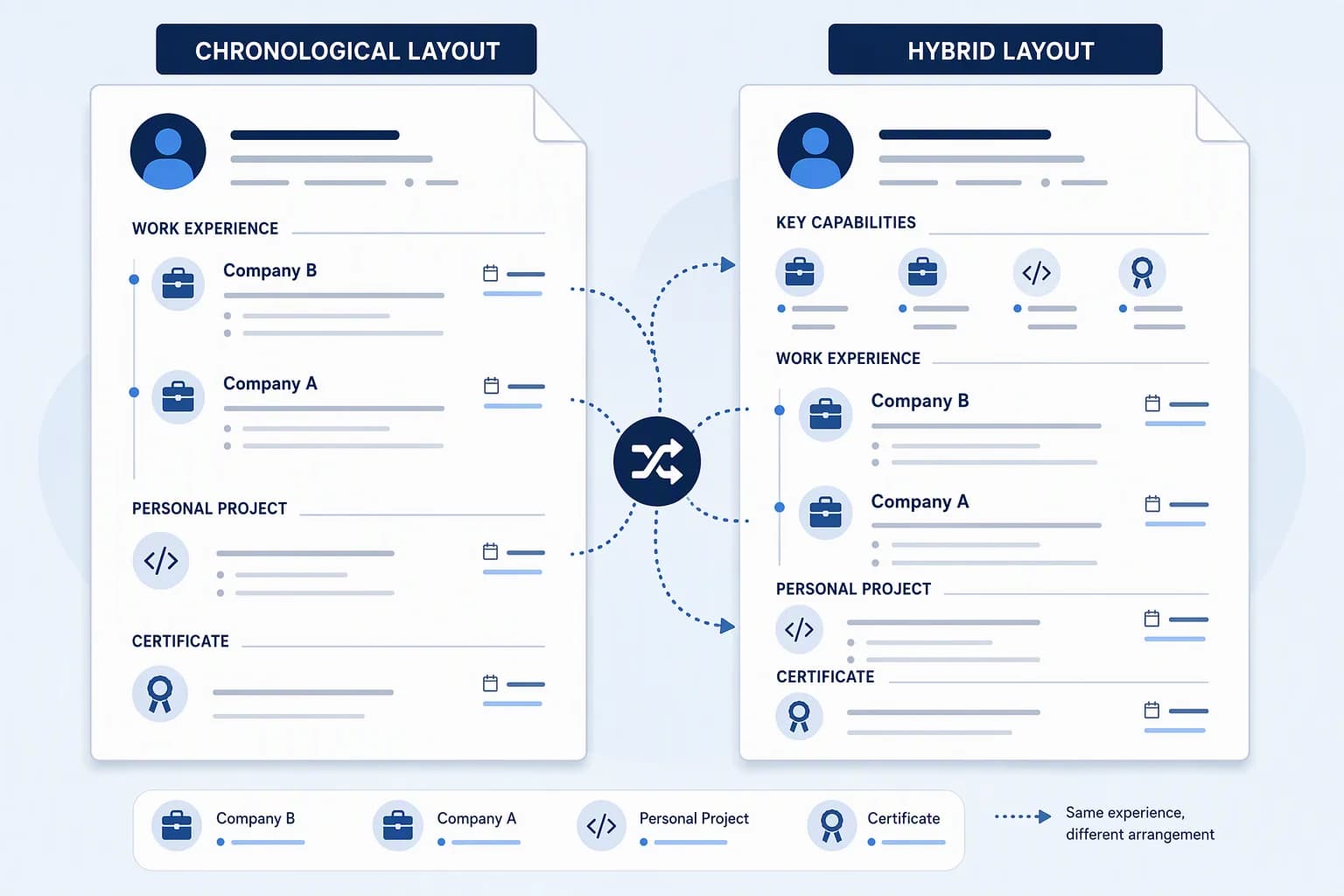
Choose a resume layout around your actual evidence. Compare chronological and hybrid arrangements of the same hypothetical experience while keeping roles, dates and personal projects clear.
Choose the layout that makes your experience clear
Choose the layout that makes your relevant experience—and where and when you gained it—easiest to understand. If recent roles already contain your strongest evidence, try a simple reverse-chronological structure first. If that evidence is spread across employment, projects and volunteering, compare a hybrid that brings related capabilities together without removing dated work history.
Neither structure is universally best. This comparison concerns information organization, not ATS compatibility or a prediction of hiring success. When browsing resume templates, decide what the sections need to communicate before choosing their visual styling.
Inventory the evidence you already have
Make a compact worksheet for the experience you want the document to show. For each relevant capability, record an action or deliverable, its setting, your attributable role, dates and any unresolved detail. The aim here is to choose an arrangement, not write every application-specific bullet.
Harvard’s resume guide recommends specific, fact-based language. JMU’s format guidance connects format choice to your background, skills and the experiences you want to highlight. Our practical inference is to examine where that specific evidence is concentrated before selecting a structure.
The following rows use the hypothetical Alex example developed below; they are not employer standards or real candidate records.
| Relevant capability | Concrete action | Setting, role and organization | Dates | Possible placement | Unresolved detail |
|---|---|---|---|---|---|
| Defect investigation | Documented reproducible defects | Employment: customer support, fictional Company A | September 2022–December 2024 | Under the role; optionally referenced in hybrid emphasis | No measured outcome supplied |
| API testing | Completed a personal API-testing project using Python and pytest | Personal project: Alex | March–May 2026 | Dated projects section; optionally referenced in hybrid emphasis | No test coverage or deployment supplied |
Find the evidence pattern without inventing a score
Ask whether your strongest examples sit mainly in recent roles or across several settings. Here, evidence density simply means how much relevant, specific evidence a section contains. It is not a score, a validated threshold or a hiring predictor.
Keep uncertainty visible in your working notes. A missing outcome is a reason to avoid an outcome claim, not an invitation to invent a percentage.
Understand reverse-chronological structure: dated experience leads
JMU describes a chronological resume as organizing work and experience around dates, with the most recent entries first within each heading. In this article, reverse-chronological means that most-recent-first arrangement. See JMU’s definitions of resume formats.
Actions sit beneath the roles or projects where they happened. This can keep the connection between a contribution and its context straightforward, without adding another section that repeats the same material.
Understand hybrid structure: capabilities alongside dated history
We use hybrid as an editorial synonym for JMU’s combination format: work or experience sections alongside functional or transferable-skills sections. It is not a skills-only functional resume that de-emphasizes employment context. JMU’s combination-format explanation establishes that distinction.
For this comparison, a hybrid foregrounds evidence-backed capabilities while retaining recognizable employers, roles and dates. Its potential value is connecting related evidence from different settings. Its extra burden is attribution: the reader must still know which activity happened in which role or project.
Section priority is not the same as chronology
Harvard recommends ordering headings by importance and listing information within headings in reverse chronological order. Those are separate decisions: moving projects or education earlier does not require removing dates. See Harvard’s section-order guidance.
For readers with limited work experience, the National Careers Service suggests placing education after the introduction and drawing on projects, work experience or volunteering. For readers with substantial experience, it suggests considering work history before education. These are situational recommendations, not one mandatory order.
Colors, icons and decorative elements are another choice entirely. They do not supply missing evidence.
One hypothetical profile, two arrangements
Alex is an invented applicant seeking a junior QA role. Both companies are fictional. The following facts are the complete ledger for the comparison:
- Company A: customer support, September 2022–December 2024; documented reproducible defects.
- Company B: software support, January 2025–present; reproduces API failures and collaborates with QA.
- Personal project: completed an API-testing project, March–May 2026, using Python and pytest.
- Education: completed a computing certificate in June 2026.
Keep the comparison’s facts and limits fixed
No measured results, production ownership, proficiency level or certificate provider are supplied. Neither arrangement adds them. The maps below illustrate emphasis; they are not full resumes or universal section checklists.
Arrangement A: reverse-chronological experience first
Section map: contact details → work experience → personal project → education.
Arrangement B: hybrid emphasis, with history intact
Section map: contact details → testing and defect-investigation emphasis → work history → personal project → education.
Choose with an unscored decision matrix
This matrix is editorial reasoning, not employer research or a tested selection algorithm. It compares where evidence becomes visible; it does not predict interviews or hiring outcomes.
| Evidence profile | What chronological organization makes visible | What hybrid emphasis could add | Safeguard | Reasoned first choice |
|---|---|---|---|---|
| Relevant evidence concentrated in recent roles | Actions, role context and dated progression together | A short capability overview, if it adds information | Avoid repeating the same bullets | Try reverse-chronological first |
| Relevant evidence spread across work, projects or volunteering | Each contribution in its original setting | Connections between related capabilities across settings | Attribute each example and retain dated history | Compare a hybrid with the simpler version |
| Limited employment, substantial education or projects | Dated learning and project entries within their sections | A focused overview of evidence across learning settings | Keep non-employment labels explicit | Try education- or projects-first order; add hybrid emphasis only if useful |
| Too little specific evidence to explain the claims | Makes the missing detail apparent | No reliable substitute for missing evidence | Clarify actual actions and remove unsupported claims | Improve the evidence before changing layout |
Use your evidence pattern, not a career label
A career change alone does not select the hybrid row. Your actual examples may already be clear beneath dated roles. Likewise, an experienced applicant may have important evidence outside recent employment.
Check application instructions and market limits
Check what the actual application requests separately from general career advice. The sources used here provide US university guidance and England-focused employment-CV guidance. They do not establish universal country requirements or Polish-market rules. In the National Careers Service source, CV means an employment document, not an academic CV.
References show why a universal section checklist would be misleading. Harvard advises against listing references. The National Careers Service page initially includes references in its broad sections list, but later says you might include a references section and should not put another person’s contact details on the CV. Harvard also explicitly notes that resume guidelines vary between countries.
Treat these as contextual recommendations. If instructions are ambiguous, ask the employer what is required rather than adding every section from every guide.
Run a short readability and choice check
The National Careers Service recommends consistent styling, headings and bullet points; Harvard recommends readable organization and balanced white space. These CV readability recommendations and resume presentation recommendations apply independently of which structure you choose.
Use this final checklist:
- Can a reader find the relevant actions without relying on unsupported skills labels?
- Can they identify the setting and your contribution for each example?
- Can they follow employers, roles and dates without reconstructing the timeline?
- Are personal projects clearly distinct from employment?
- Does each extra section add a useful connection rather than repeat achievements?
- Are headings clear and styling consistent, with enough space to distinguish entries?
- Have you removed claims that go beyond what you actually did?
State your choice and take the next step
Finish with one sentence: “I will start with [structure] because [my evidence pattern], while keeping [timeline and attribution safeguards].”
For Alex, one reasonable choice is: “I will compare a hybrid because my testing-related evidence spans support roles and a personal project, while keeping both jobs dated and the project explicitly personal.” That is a rationale for trying an arrangement, not proof that it will perform better.
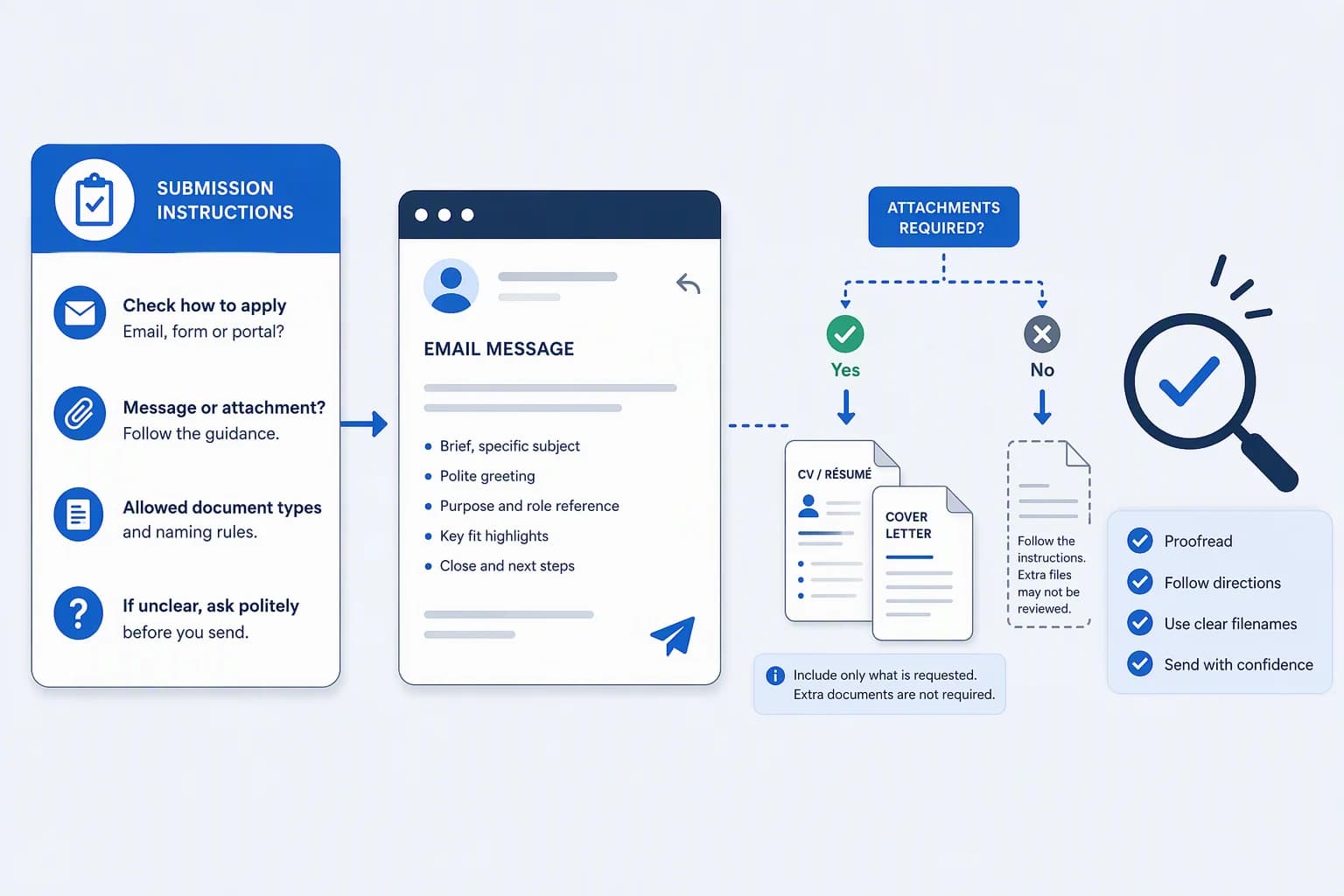
Next, tailor the chosen structure with evidence. Where submission expectations remain unclear, use these questions to clarify the employer’s application requirements.
Source dates and applicability
The following guidance was retrieved on October 4, 2026. The sources’ last substantive update dates and change histories were not established.
Career Center: Choosing a Résumé Format — James Madison University, University Career Center. Accessed October 4, 2026. Publication/update date unknown; the displayed October 13, 2025 date is unlabeled. US university/student guidance.
Harvard College Guide to Creating a Strong Resume — Harvard University, Mignone Center for Career Success. Accessed October 4, 2026. Publication metadata: July 11, 2024; last substantive update unknown. US college-resume guidance.
How to write a CV — National Careers Service. Accessed October 4, 2026. Publication/update date unavailable. England-focused employment-CV guidance.
Sources and further reading
- Career Center: Choosing a Résumé FormatJames Madison University, University Career Center · Accessed
- Harvard College Guide to Creating a Strong ResumeHarvard University, Mignone Center for Career Success · Accessed
- How to write a CVNational Careers Service · Accessed